The Locked Tomb
Thu, 05 Nov 2026 00:00:00 GMT
I can't believe I haven't written about The Locked Tomb yet! Admittedly, I haven't written much of anything over the past few years; but I should at least have written about this!
The Locked Tomb is a sci-fi / fantasy series by Tamsyn Muir, and I think they might be my favorite books ever. They're absolutely incredible, and I love them so, so, so much. In this post, I'll try to say a few words about why while doing my best to avoid spoilers of any kind.
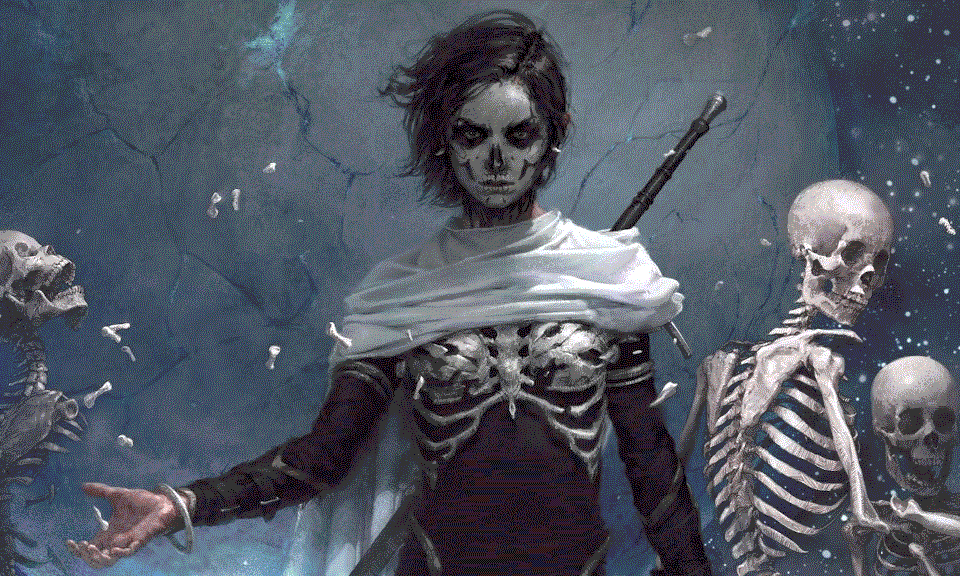
"Lesbian necromancers explore a haunted gothic palace in space!" is Charles Stross's famous tagline for the first book of the series, Gideon the Ninth. It's a fantastic tagline, and he's not wrong; but I hasten to add that the books stubbornly resist easy classification at every turn. Every time you think you've got them figured out, they turn another corner and show you how deeply naive you were. Yes, there are necromancers, but their powers are probably quite different from other necromancers you might've read about. And not all of them are necromancers: some wield swords, some are nuns, some are princesses, some are reanimated corpses, some are just average people with no special talents or skills. Yes, some of them are lesbians, but most of them fall all across the gender and sexual orientation spectra. Yes, there's a (potentially) haunted palace-like structure, but this is no ordinary horror story, and your feeble imaginings and guesses won't bring you within light-years of the truth. Yes, the book has gothic elements, but it never takes itself too seriously and yet somehow still manages to pack the emotional punch of several wrecking balls — if those balls are actually planets. And yes, some parts of the stories take place in space; but space is treated mostly as an obstacle to overcome on the way from A to B. One moment, you think you'll have the genre pegged, but then the books will simply laugh at you and move on to their next spectacle, leaving your jaw on the floor and little cartoon birds spinning over your head. They'll have you laughing out loud one moment, crying the next, completely mystified after that, and finally prostrating yourself in awe before Muir's towering genius every time a new piece clicks into place.
These books do not hold your hand. You're dropped into the story with very little exposition, and Muir puts her full trust in you as a reader to figure things out for yourself. For these reasons, the books continually reward re-reading: every time through, you'll find umpteen new things that'll blow your mind and reshape what you thought you knew. Oh, and I should add that the last book in the series, Alecto the Ninth, hasn't been published yet! I've read through the first three books several times now, trying desperately to construct a narrative that fits all the pieces; and yet, because so much is still unknown, my theories are shaky at best.
These books are a long meditation on loss and grief. Of course, there's plenty of hilarity, romance, and action as well; but having necromancy as a central mechanic in the books allows Muir to blur the lines between life and death and, in doing so, to ponder the meaning of each. Can necromancers bring people back to life, or can they merely puppet dead bodies? If they can't bring people back to life, then why not? Is it a lack of understanding, a lack of power, a taboo enforced by the laws of nature, or something else? What does it mean to give your life to someone, or for someone? How can we face the fact that (as one of her characters puts it) "life is too short and love is too long"? The more I say about this aspect of the books, the more I risk making it sound cheap or shallow or one-note; so I'll stop here. But, to me, the books read as having been written by someone who deeply understands grief and loss.
The books are made of many threads, from Christian themes to elements of Maori culture, from sci-fi and fantasy tropes (and their subversions) to memes from Tumblr and Reddit, from dad jokes to Greek mythology, and more. Here, the sheer depth and breadth, layer upon layer, reference upon reference, causes my brain to grind to a halt at the prospect of trying to write about it all. And yet, it never feels heavy as it goes down; it's all light and smooth and delicate and subtle. The layers and references are there for you to find and appreciate, but the books don't lock you out if lack the relevant scholarly or memelordly credentials.
And the characters, oh, the characters! They're so beautiful, so real and alive (at least in the metaphorical sense 😂), so full of joy and sorrow, love and lust, generosity and jealousy, humility and pride, humor and seriousness, forgiveness and vengeance, virtue and pettiness, honor and shame, and a million other shades of emotion and personality. I want to reach into the books and meet them all in person and give them all big hugs.
Anyway, I'll stop there for now. (It's a good thing I've restricted myself to avoiding spoilers or else I might've ended up writing my own tomes of commentary and speculation.) I highly recommend these books, though I admit that they probably won't be every reader's cup of tea. Enjoy!